At a Glance
Best For
Overview
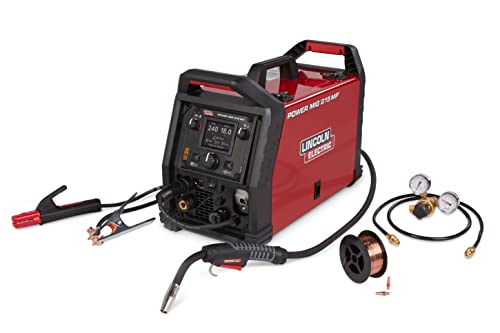
The Lincoln Power MIG 210 MP is the welder that ends the 'which process should I learn?' debate by saying 'all of them.' MIG, flux-core, DC TIG, and stick — one machine, one $949 purchase, four welding processes. For the home shop welder who's outgrown a single-process machine and isn't sure whether the next welder should be a dedicated TIG, a higher-amp MIG, or a stick rig, the 210 MP offers a different path: don't choose, get all three.
This isn't a beginner's first welder. At $949 it's priced above the 'I want to try this' tier. The buyer is someone who's done a year or two of MIG, knows they want to keep welding, and is ready to invest in capability. The 210 MP rewards that investment with genuinely excellent MIG performance (this is Lincoln's professional-tier MIG architecture in a portable package), competent DC TIG for shop work, and reliable stick capability for outdoor and field welding.
The machine that competes most directly is the Miller Multimatic 215 ($1,599). The Miller is better on every metric — better TIG, smoother MIG arc, more inputs and outputs, sturdier construction. But it's $650 more expensive. The Power MIG 210 MP exists for the buyer who wants real multi-process capability without crossing $1,000.
Pros & Cons
Pros
- True multi-process: MIG, Flux-Core, DC TIG, Stick in one unit
- Dual voltage 120V/230V — grow with your shop
- Color LCD interface with process-specific settings
- Spool gun capable for aluminum MIG work
Cons
- Premium price — nearly $1,000 at retail
- TIG performance lags dedicated TIG machines at this price
- Interface complexity can frustrate pure beginners
Lincoln Electric Power MIG 210 MP Multi-Process Welder
Prices may change · Free shipping with Prime
MIG Performance — The Core Strength
The Power MIG 210 MP's MIG capability is its strongest argument. The arc is smooth and forgiving across the amp range, the wire feed is rock-solid (this is Lincoln's professional drive system, the same architecture from their PowerMIG industrial line), and the dual voltage 120V/230V flexibility means you can run anywhere from light sheet to 3/8" structural in one machine.
At 210A peak output on 230V, you're hitting the same amperage as dedicated production MIGs in commercial shops. Duty cycle is 40% at 150A — meaning sustained, real-world welding at typical mid-amperage settings. That's enough to run long beads on trailer fabrication, fence frames, and structural projects without the thermal trips that plague cheaper multi-process machines.
The color LCD interface is also genuinely useful for MIG-specific reasons. It shows wire-speed-to-voltage relationships in real time, lets you save material/wire combinations as job presets, and walks new users through wire size, gas type, and material thickness setup without needing the door chart. After a few months you stop using the interface much and just dial settings by feel, but it shortens the learning curve significantly.
TIG Performance — Capable but Not Class-Leading
The 210 MP's TIG is DC-only, lift-start, with foot pedal capability sold separately. That immediately tells you what it can and can't do. It welds mild steel and stainless steel cleanly. It does not weld aluminum (which requires AC TIG to break the oxide layer with high-frequency arc reversal).
For a home shop welder learning TIG on mild steel — exhaust work, sculpture, fine fabrication, gate hinges — the 210 MP's TIG mode is more than enough. The arc is stable, the lift-start works reliably, and the amperage control is precise enough for thin-gauge work where 30–60A is the active range.
Where it falls short of dedicated TIG machines: no AC for aluminum, no high-frequency start (lift-start requires touching the tungsten to the workpiece briefly, which can contaminate the tungsten if technique is sloppy), no pulse capability for advanced thin-gauge or stainless work. The Lincoln Square Wave 200 at the same price tier ($1,299) does TIG much better — AC/DC, high-frequency start, pulse modes — but only does TIG and stick. The 210 MP's TIG is a 'good enough to learn on and use for everyday shop work' implementation, not a precision TIG machine.
Stick and Flux-Core — The Reliable Fallbacks
Stick mode (SMAW) on the 210 MP is competent and uses the same Auto-Line input flexibility as the MIG side. It handles 6010, 6011, 6013, and 7018 rods reliably. Amperage runs 20–210A. For a multi-process machine the stick capability is genuinely useful — you can switch from MIG to stick in 30 seconds (swap the gun cable for a stinger) when you need to weld outdoors in wind, on rusty/dirty material that MIG would struggle with, or on heavier sections where stick's higher heat input is preferred.
Flux-core (FCAW) is just a wire-and-polarity change from MIG, and the machine handles it the same way it handles solid wire MIG. Outdoor welding, no shielding gas, more penetration, more spatter, slag chipping required.
Neither stick nor flux-core is the reason you buy this machine. They're the reason you keep it when other tasks come up. A dedicated stick welder will be cheaper and slightly more reliable for stick-only work. The value here is having all four processes on one bench.
Aluminum Capability via Spool Gun
The 210 MP supports the Lincoln Magnum 100SG spool gun (sold separately, ~$300), which mounts the aluminum wire spool at the gun for short, straight feed path. This is the standard solution for MIG aluminum welding — the soft 4043 or 5356 aluminum wire kinks if you try to push it through a standard 6-foot MIG gun cable, so the spool gun eliminates the cable run.
With the spool gun installed, the 210 MP welds aluminum from 16-gauge through 3/16" reasonably well. It's not as smooth as a dedicated AC/DC TIG aluminum weld (which is the gold standard for aluminum), but it's faster, easier to learn, and produces structurally sound welds for fabrication work — aluminum trailers, boat repair, structural fabrication.
If aluminum is a primary use case, you're probably better served by a dedicated AC TIG machine. The Lincoln Square Wave 200 at $1,299 produces visibly better aluminum welds via AC TIG than the 210 MP's spool gun MIG. The 210 MP's aluminum capability is best understood as 'good enough for occasional structural aluminum work, not for fine aluminum craft.'
Power MIG 210 MP vs Miller Multimatic 215
The direct competitor is the Miller Multimatic 215 at $1,599. Both are multi-process machines (MIG/TIG/Stick/Flux-Core), both dual voltage 120V/230V, both target the serious home shop and small commercial buyer.
Miller Multimatic 215 advantages: smoother MIG arc (Miller's arc control technology is widely considered the best in the industry), better TIG performance (includes high-frequency start standard, more refined low-amp control), Auto-Set feature that automatically dials in voltage and wire speed when you input wire size and material thickness, sturdier overall build with better cable management.
Lincoln Power MIG 210 MP advantages: $650 cheaper, color LCD interface is more intuitive than the Miller's smaller display, slightly lighter (40 lbs vs Miller's 56 lbs), Lincoln's MIG arc characteristic preferred by some welders for thicker material penetration.
For pure quality, the Miller wins. For value-per-capability, the Lincoln wins. The right call depends on whether the extra $650 represents 'meaningful upgrade' or 'overspend' in your situation. For most home shops the Lincoln is the smart buy. For semi-professional or daily-use shops, the Miller justifies the premium.
Our Verdict
The Power MIG 210 MP is the ideal upgrade path for welders who want to explore multiple processes without buying separate machines. MIG performance is genuinely excellent; TIG is capable for shop use. At $949, it's the right choice if you're serious about the craft long-term.
Lincoln Electric Power MIG 210 MP Multi-Process Welder
$949
Prices may change · Free shipping with Prime
| Full Specifications | |
|---|---|
| Process | MIG / TIG / Stick / Flux-Core |
| Amp Range | 20–210A |
| Max Amps | 210A |
| Duty Cycle | 40% @ 150A |
| Input Voltage | 120V / 230V |
| Wire/Rod Gauge | 0.025–0.045 in solid; 0.030–0.045 in flux-core |
| Max Metal Thickness | 3/8 in |
| Weight | 40lbs |
| Auto-Set | Yes |
| Spool Gun Ready | Yes |
| Warranty | 3yr |
| Brand | Lincoln Electric |
Frequently Asked Questions
Can the Power MIG 210 MP weld aluminum?
Is the Power MIG 210 MP good for a beginner?
What's the difference between MIG and TIG, and do I need both?
Does the Power MIG 210 MP run on a regular outlet?
Related Buying Guides
Compare With Similar Welders
Head-to-Head Comparisons
Lincoln Electric Power MIG 210 MP Multi-Process Welder
$949
Prices may change · Free shipping with Prime