At a Glance
Best For
Overview
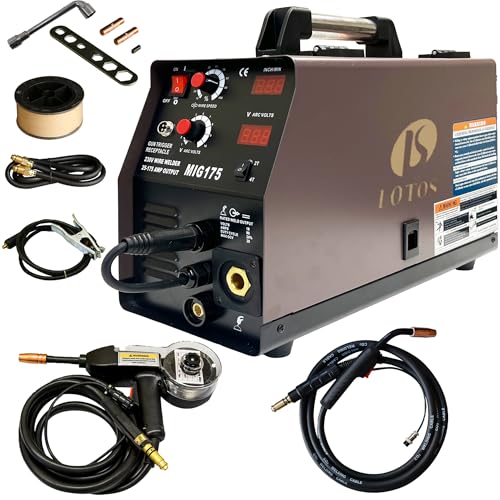
The Lotos MIG140 is the welder that breaks the rule that says you can't get a real dual-voltage MIG machine for under $300. At $299 retail, it includes a 140-amp MIG/flux-core inverter, dual 110V/220V input, a starter spool of flux-core wire, a basic MIG gun, ground clamp, and gas regulator. Out of the box, in the box, ready to weld.
This is the machine that gets disproportionately recommended on r/welding for one specific buyer: someone who wants to try MIG welding without committing $500+ to a Hobart Handler 140, and who isn't sure yet whether welding will become a serious hobby or stay a one-off project for a backyard fence. At $299, the financial downside of buying wrong is acceptable.
The Lotos MIG140 will not perform like a Miller. It will not perform like a Hobart. It is a budget Chinese-manufactured inverter MIG that does what budget Chinese inverters do — works reliably for light to medium use, struggles with consistency at the extremes, and lasts 5–10 years of hobby use rather than 25 years of professional use. Understanding that trade-off is the entire question of whether this welder is right for you.
Pros & Cons
Pros
- Dual voltage 110V/220V — works in any garage or shop
- Includes flux-core wire — ready to weld out of the box
- Very competitive price for a dual-voltage MIG
- Solid build for the price point
Cons
- Wire feed can be inconsistent at very low settings
- Duty cycle is modest — not for long production runs
- Limited brand support infrastructure vs Miller/Lincoln
Lotos MIG140 140A MIG Welder
Prices may change · Free shipping with Prime
Dual Voltage in a $300 Machine — Why It Matters
Most welders under $400 are 110V only. The Hobart Handler 140 is 110V only at $489. The Lincoln Easy MIG 140 is 110V only at $599. Dual voltage at this price point is genuinely uncommon.
What dual voltage gets you: the ability to plug into a standard household 110V outlet for thin gauge work (auto body panels, sheet metal, light fabrication) AND step up to 220V for thicker work (frame repair, structural work, 1/4" plate). On 220V the MIG140 reaches its full 140A rated output with better duty cycle than on 110V.
The practical use case: someone who has a 110V garage but occasionally welds at a friend's shop or buddy's farm with 220V available. Or someone planning to add a 220V circuit eventually but not yet. Dual voltage lets you buy now and upgrade your shop later without buying a new welder.
Wire Feed Quality — Where the Price Shows
This is where you feel the $300 price. The wire feed mechanism on the Lotos MIG140 is functional but not refined. At medium speeds (3–6 on the dial) it runs smoothly and lays clean beads. At very low feed speeds — the kind you need for thin 22-gauge sheet metal at 30 amps — the feed can stutter, surge, or birdnest at the wire reel.
The fix is partly technique (keep the gun positioned correctly, hold a consistent angle, don't push too slowly) and partly mechanical (clean the drive rollers regularly, replace the contact tip when copper wear shows, ensure the wire reel is clean and tensioned correctly). With practice the wire feed becomes predictable.
For comparison, the Hobart Handler 140's wire feed is notably smoother across all speeds. That's a meaningful part of why the Handler costs $189 more. If you weld a lot of thin sheet (auto body restoration, HVAC sheet metal), the Hobart is worth the upgrade. For general garage fab in 1/16"–1/8" range, the Lotos is fine.
Flux-Core Included — What That Means
The Lotos MIG140 ships with a starter spool of 0.030" flux-core wire. That means you can plug it in, load the spool, and weld immediately — no shielding gas, no MIG gas regulator setup, no trip to the welding supply for a cylinder.
Flux-core welding is uglier than gas-shielded MIG. The weld bead has more spatter, the slag layer needs chipping, and the visual result on the same joint won't match what proper MIG would deliver. But it works outdoors (gas MIG fails in wind), it penetrates thicker material with less heat input, and it doesn't require buying a $200+ gas setup before you can try the machine.
The right approach for most buyers: run flux-core for the first month while you learn the basics and verify the welder fits your needs. Then upgrade to gas MIG for cleaner work on visible joints. The MIG140 supports both — you just need a gas regulator (around $40) and a CO2/argon mix tank ($150–250 deposit + $40 refill).
Duty Cycle Reality and Heavy-Use Limits
30% duty cycle at 90A means: in any 10-minute window, you can weld at 90 amps for 3 minutes before thermal protection kicks in. At 140A max, the duty cycle drops further — closer to 20% at peak output.
For home shop use this is rarely a real constraint. Most hobby projects involve short beads, repositioning, measuring, tacking — the welder is hot for less than 30% of the actual session. Run a quick stitch weld, fit the next piece, run another bead. The machine cools between welds.
Where duty cycle bites: long uninterrupted seams (welding a long fence rail, fabricating a trailer bed, building a roll cage). Anything where you'd want to lay 3+ feet of continuous bead at full power. The Lotos will hit thermal protection, shut down, and you'll wait 5–10 minutes for it to cool. A Hobart Handler 140 in the same scenario would last longer but eventually also overheat. Real production work needs a 60%+ duty cycle machine — different price tier entirely.
Who Should Buy This (and Who Should Skip It)
Buy the Lotos MIG140 if you're new to welding, have under $400 to spend total (machine + helmet + basic supplies), and want to try the craft without major financial commitment. It's also the right choice if you specifically need dual voltage and the next price tier ($500+) is out of reach.
Skip it if you already know welding will be a serious long-term hobby or income stream. Spend the extra $189 on a Hobart Handler 140 (better wire feed, 5-year warranty, established dealer support). The Hobart will still be running well in 2040; the Lotos probably won't.
Also skip it if you need warranty support or established service channels. Lotos warranty is 1 year and the support infrastructure is thin. Miller/Hobart/Lincoln have parts and authorized service centers nationwide. A Lotos that develops a wire feed issue in year 2 is generally not worth repairing — you replace it.
The right framing: the Lotos MIG140 is the welder you buy to find out if you want a Hobart Handler 140.
Our Verdict
The Lotos MIG140 punches well above its price. Dual voltage input and flux-core included makes it the smartest budget entry point for home MIG welding. Don't expect commercial duty cycles — but for garage fab work, it delivers.
Lotos MIG140 140A MIG Welder
$299
Prices may change · Free shipping with Prime
| Full Specifications | |
|---|---|
| Process | MIG / Flux-Core |
| Amp Range | 30–140A |
| Max Amps | 140A |
| Duty Cycle | 30% @ 90A |
| Input Voltage | 110V / 220V |
| Wire/Rod Gauge | 0.023–0.035 in solid; 0.030–0.035 in flux-core |
| Max Metal Thickness | 1/8 in |
| Weight | 40lbs |
| Auto-Set | No |
| Spool Gun Ready | No |
| Warranty | 1yr |
| Brand | Lotos |
Frequently Asked Questions
Will the Lotos MIG140 weld 1/4 inch steel?
Can I use this welder for auto body work?
Do I need to buy gas for this welder?
How long will the Lotos MIG140 last?
Related Buying Guides
Head-to-Head Comparisons
Lotos MIG140 140A MIG Welder
$299
Prices may change · Free shipping with Prime